

Frictionless Property Registration
Balancing speed and listing quality through guided UX and AI-assisted prototyping
Company details omitted for confidentiality. Focus on design strategy and process.
Role: Senior Product Designer
Scope: End-to-end
Timeline: 20 days
Context & Problem
The product is a real estate CRM used across multiple Latin American countries to manage leads and property listings for sales and rentals. With expansion into Brazil, the registration flow needed to be adapted to the local market while balancing speed and listing quality, ensuring properties were marketplace-ready.
However, the existing flow prioritized speed by reducing required information to minimize agent drop-off. As a result, many listings were incomplete, impacting:
Operational efficiency
Listing quality
Marketplace performance
Team rework
Agent confidence
✸ This revealed a critical trade-off:
Faster registration resulted in lower listing quality.
How might we adapt the property registration flow for the Brazilian market, balancing speed, completeness, and intuitive experience?
Strategic Insight
Discovery revealed the issue was not the form itself, but when completeness was required.
Separating operational registration from
marketplace-ready listing would allow
fast entry with progressive quality.
Product Strategy
Separate operational registration from listing optimization
Introduce guided step-by-step flow
Add listing quality score
Prioritize critical fields first
Provide continuous validation and feedback
✸ Expected outcomes:
Higher listing completeness
Reduced drop-off
Less operational rework
Scalable structure for new markets
Discovery
As-Is Flow Mapping
Documented full registration flow.
Identified drop-off points.
Found inconsistencies.
Heuristic Analysis
High cognitive load.
No visual progression.
Confusing fields.
Lack of feedback.
Stakeholder Alignment
Product and operations interviews.
Business pain points identified.
Strategic hypotheses defined.
Key Insights
Speed reduces completeness.
Agents prefer guided flows.
Progression increases engagement.
discovery
Guided flow reduces drop-off
Completion score increases engagement
Field prioritization improves efficiency
Separating operational vs optimization improves quality
To accelerate decision-making and quickly validate the strategic direction, I translated the product vision into a structured PRD and used AI-assisted prototyping to materialize the experience.
AI-Driven Design Process
Process:
Defined strategic product vision.
Translated product strategy into a structured PRD.
Used AI-assisted vibe coding to generate interface flows.
Iterated UX decisions directly in working UI.
Validated interaction patterns and information hierarchy.
This approach allowed:
Faster alignment between strategy and interface.
Rapid iteration of guided flow structure.
Early validation of step-by-step experience.
Reduced gap between concept and implementation.
✸ AI-assisted prototyping was used as a design thinking accelerator, not as a replacement for UX decision-making.
solution
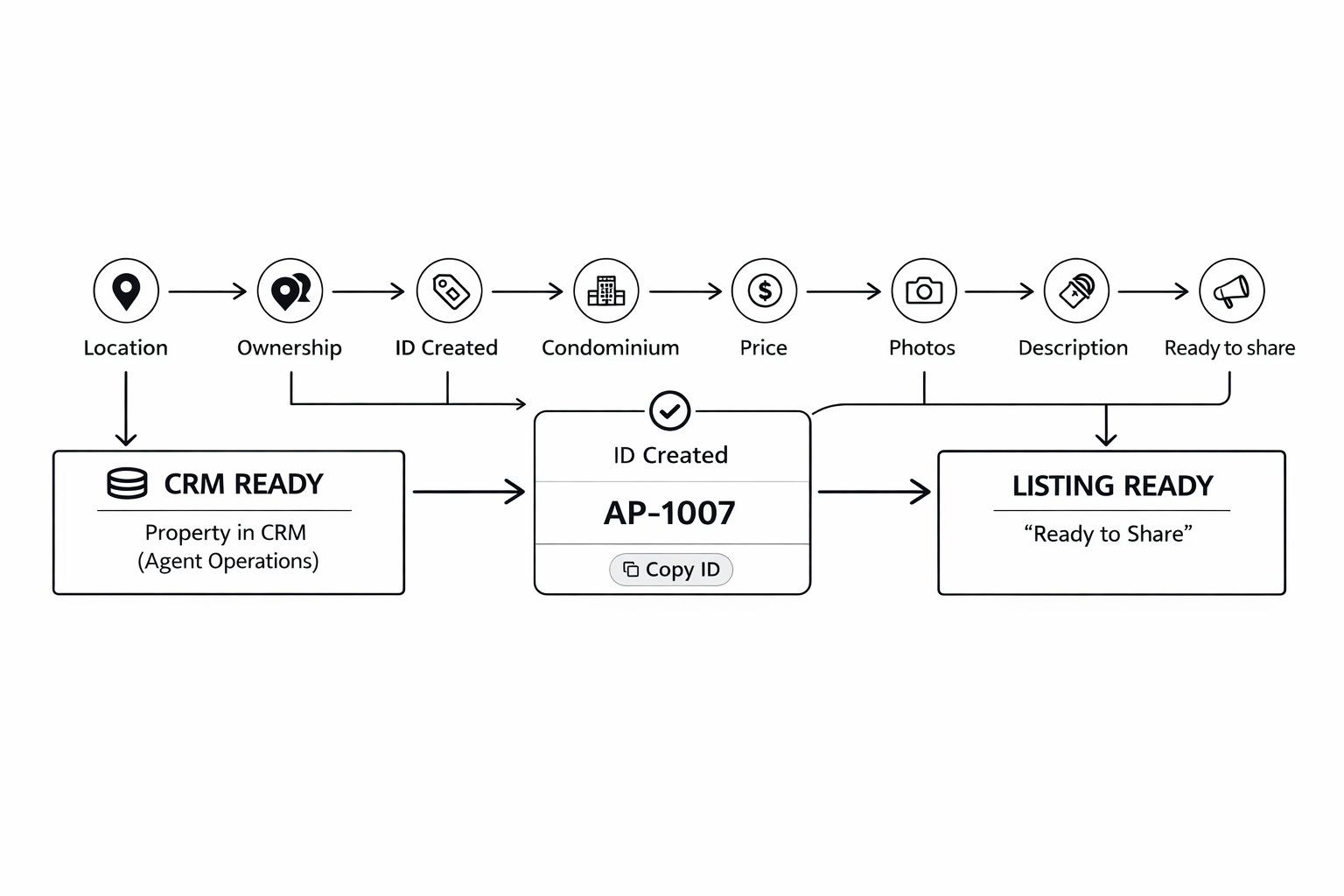
A step-by-step wizard guiding users through progressive listing completion

Step-by-step wizard
This screen follows a step-by-step wizard approach to guide users through property creation with minimal friction. By focusing on location first, the flow establishes the foundational data needed to generate a property ID early, allowing the asset to become operational in the CRM while the user continues enriching the listing.
The progressive structure reduces cognitive load, keeps the task focused, and clearly communicates progress, while the side quality panel provides real-time feedback to encourage completion and move the property toward “Ready to share.”

Operational vs publish-ready separation
Distinguishes between the minimum information required to save a property internally and the additional details needed for a high-quality marketplace listing. This approach allows agents to quickly register a property with essential operational data, reducing friction in early stages, while progressively enriching the listing with descriptions, media, and amenities before publication.
By decoupling internal workflow needs from publish-ready requirements, the design supports faster data capture, encourages iterative completion, and improves overall listing quality without blocking users upfront.
✸ Key Design Decisions
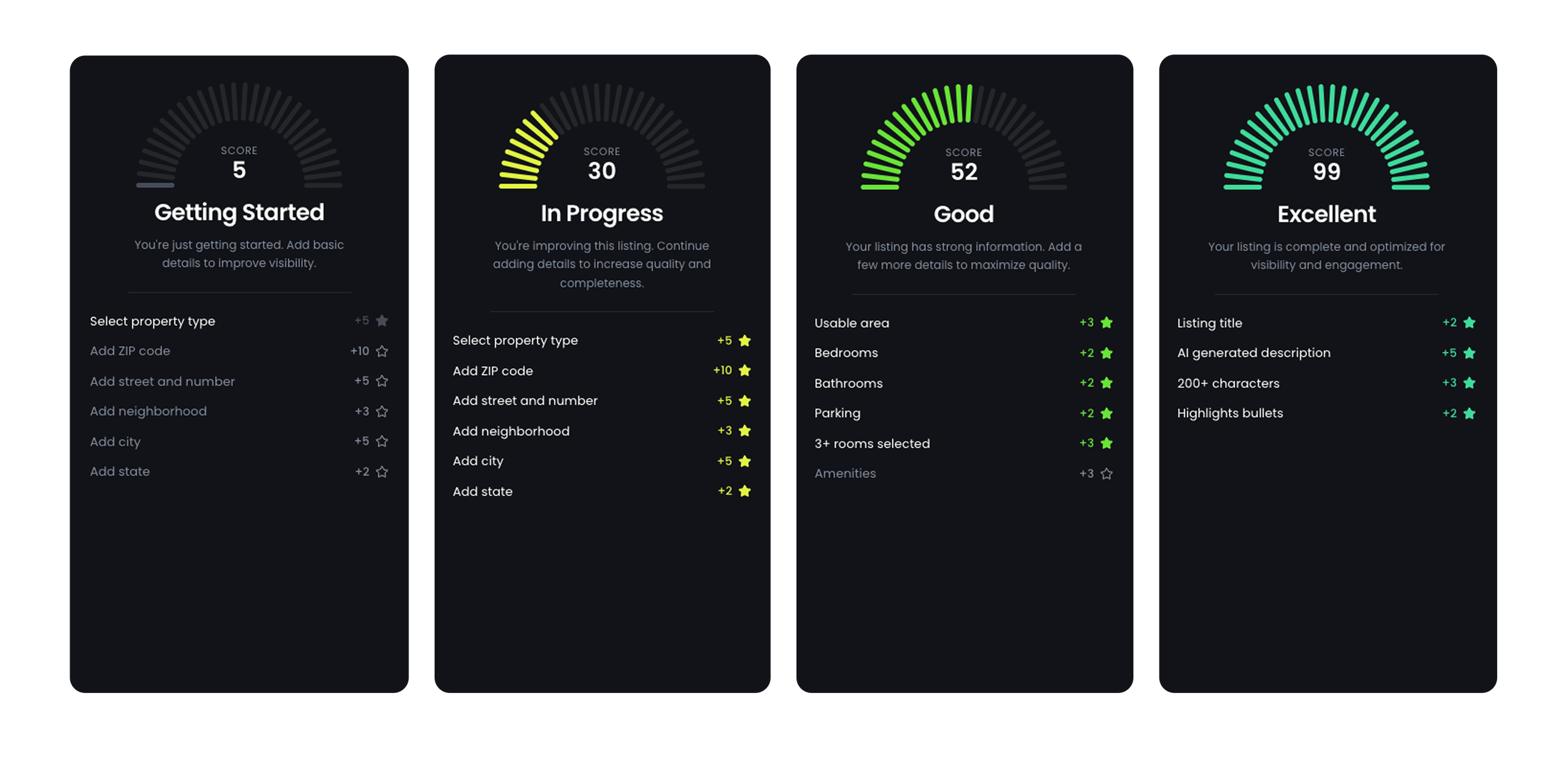
Listing quality score
Provides a dynamic indicator that reflects how complete and competitive a property listing is based on the information filled in by the user. By analyzing key elements such as description, images, amenities, and core property details, the score encourages agents to progressively enrich the listing before publishing. This mechanism guides users toward higher-quality content, improves consistency across listings, and increases the likelihood of better performance in rental and sales marketplaces without enforcing rigid requirements upfront.

Progressive disclosure
Reduces cognitive load by revealing information progressively as users move through the registration flow. Instead of presenting all fields at once, the interface surfaces only what is relevant for each step, allowing users to focus on a smaller set of decisions. This approach improves completion rates, accelerates initial data entry, and creates a more guided and approachable experience.

AI-assisted content generation
AI-assisted content generation automatically creates optimized titles and descriptions using structured property data provided earlier in the flow. This reduces manual effort while improving listing consistency and marketplace performance. By generating content at the right moment, the experience supports faster completion and helps users produce high-quality listings even with limited copywriting skills.


Try the interactive prototype
Validation & Insights
Qualitative tests with agents and real estate offices
Guided usability testing sessions
Field prioritization feedback
Score comprehension validation
Rapid iteration cycles
Progressive steps reduced perceived effort
Quality scores increased engagement
Operational vs publish-ready separation improved clarity
Impact & Metrics
Increased listing completeness
Reduced drop-off across registration steps
Optimized average registration time
Improved perceived listing quality
Higher completion score usage
Reduced operational rework
Better agent experience
Increased confidence in the system
Scalable structure for LatAm expansion
Next Steps
Smart listing optimization recommendations
Continuous metrics monitoring
Expansion to new markets
Wizard personalization based on behavior