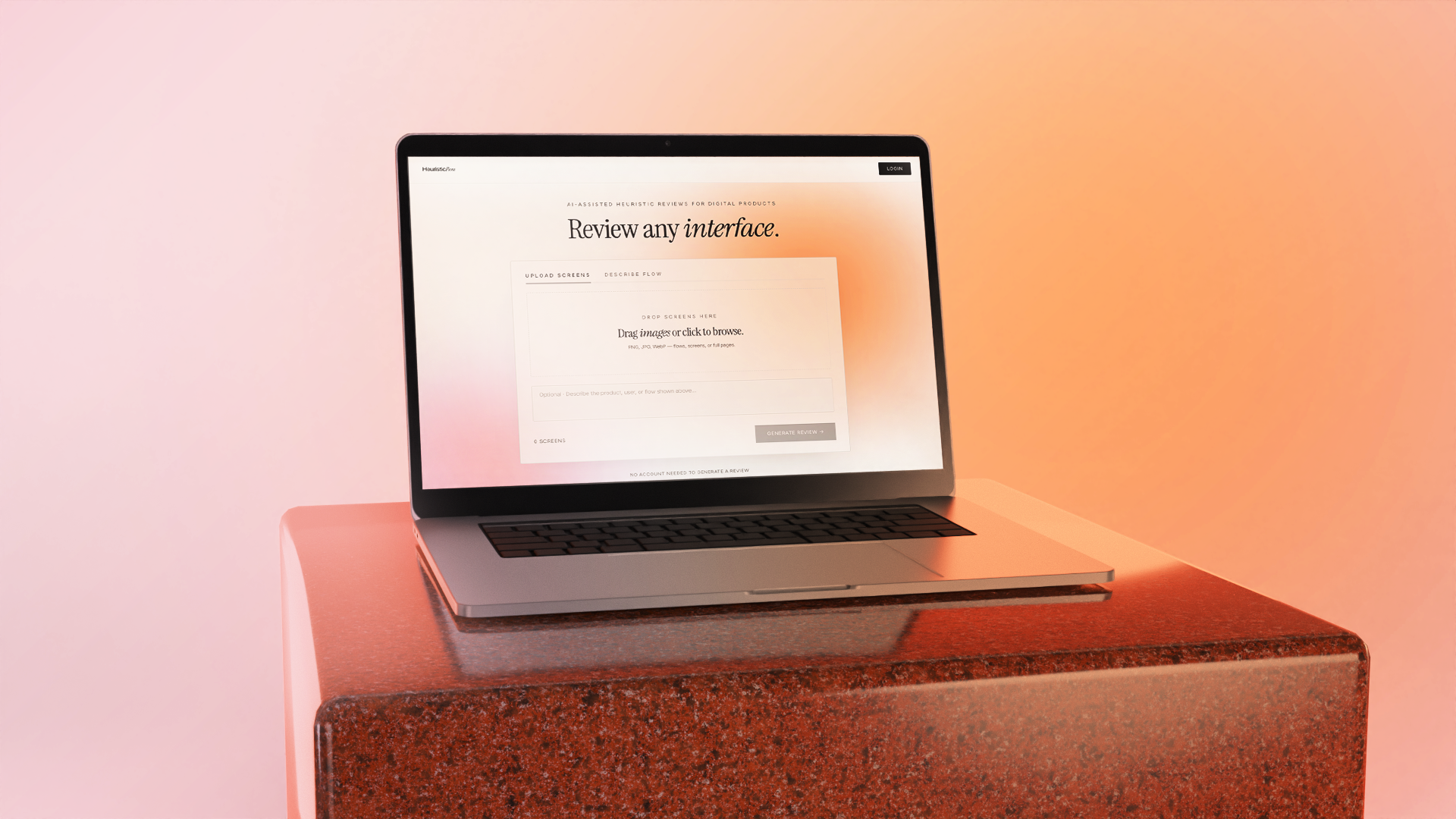
From Hypothesis to Product in 3 days
Role: Product Designer • Product Builder
Scope: End-to-end product definition, UX design, AI workflow structuring, backend integration, authentication, persistence architecture, prompting strategy, and deployment.
Timeline: 3 days
Timeline: Lovable • Supabase • OpenAI API • PostgreSQL
Building an AI-first UX Review Assistant Through Rapid Validation
Context
Over the past few months, I’ve been exploring how AI changes not only interfaces, but the entire speed of product creation and learning.
Instead of treating AI as just another feature, I became interested in AI-first workflows capable of reducing the distance between:
hypothesis;
building;
validation;
learning.
This project emerged directly from that exploration.
The goal was not to build a startup-ready platform.
It was to answer a simple question:
How far can a Product Designer go in rapidly transforming a product hypothesis into a functional software experience using AI-assisted workflows?
problem
Heuristic reviews are often highly manual processes.
They typically involve:
repetitive synthesis work;
inconsistent documentation;
slow evaluation cycles;
low scalability across teams.
At the same time, product teams frequently struggle to convert qualitative feedback into structured and actionable insights fast enough to support decision-making.
This creates a gap between:
identifying usability problems;
synthesizing findings;
turning feedback into product direction.
Hypothesis
My hypothesis was that AI could significantly accelerate heuristic analysis through an intentionally simple workflow:
1.the user describes an interface or flow.
2. the AI processes the analysis.
3.the system returns a structured heuristic review.
No complex dashboards.
No multi-workspace architecture.
No unnecessary feature expansion.
The focus was speed, usability, and validation of the core workflow.
Product Strategy
The most important decision in this project was aggressive scope reduction.
Instead of building a full platform, I focused exclusively on validating the core assumption:
“Can AI-assisted heuristic reviews generate immediate value with minimal friction?”
That decision shaped the entire MVP architecture.

What Made It Into the MVP
To protect execution speed and maintain focus, I deliberately excluded:
PDF uploads;
OCR;
collaboration systems;
analytics dashboards;
vector databases;
AI chat interfaces;
exports;
advanced design systems;
multi-project workspaces.
This was a product decision — not a technical limitation.
The objective was maximizing learning per unit of execution time.
Product Architecture

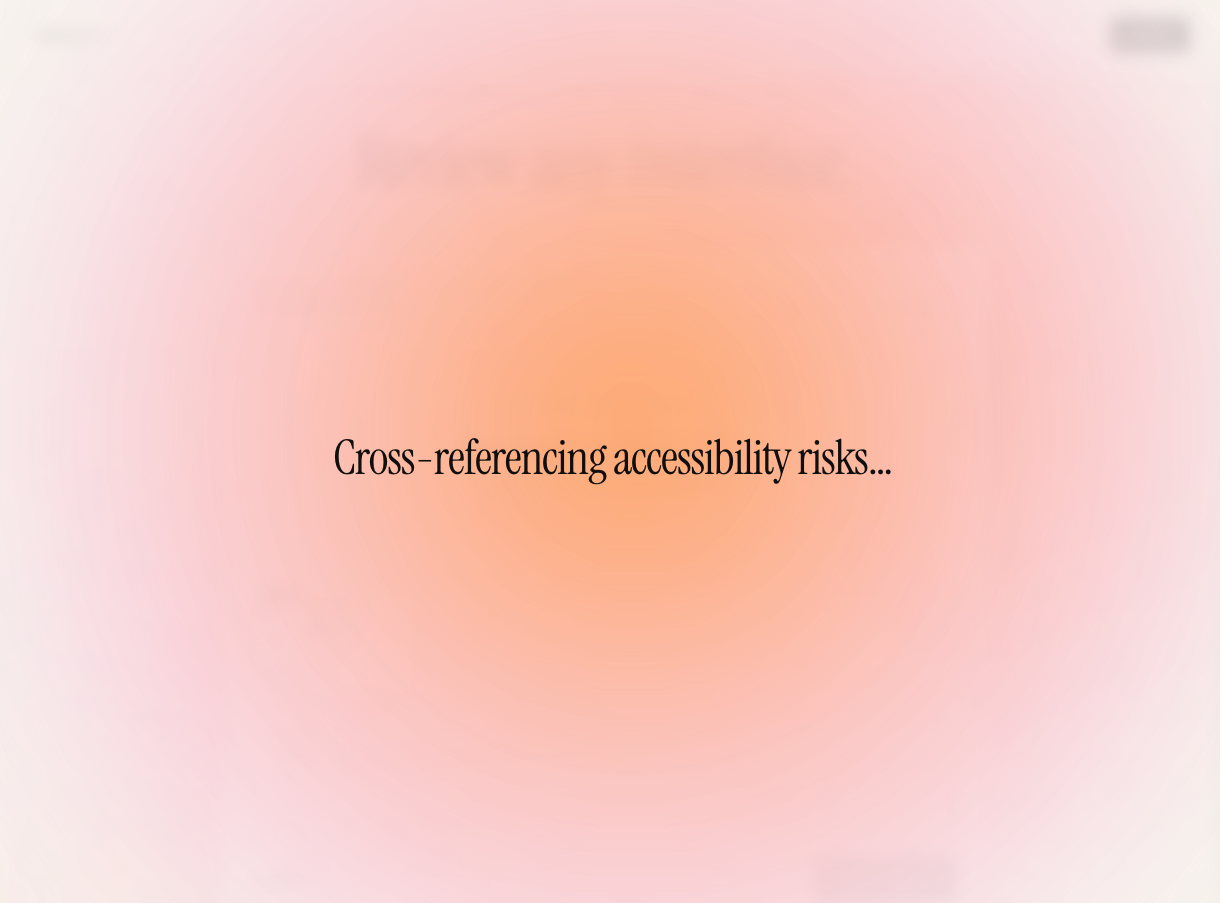
The system was designed to minimize operational complexity while maximizing the feeling of a real product experience.
✸ Review
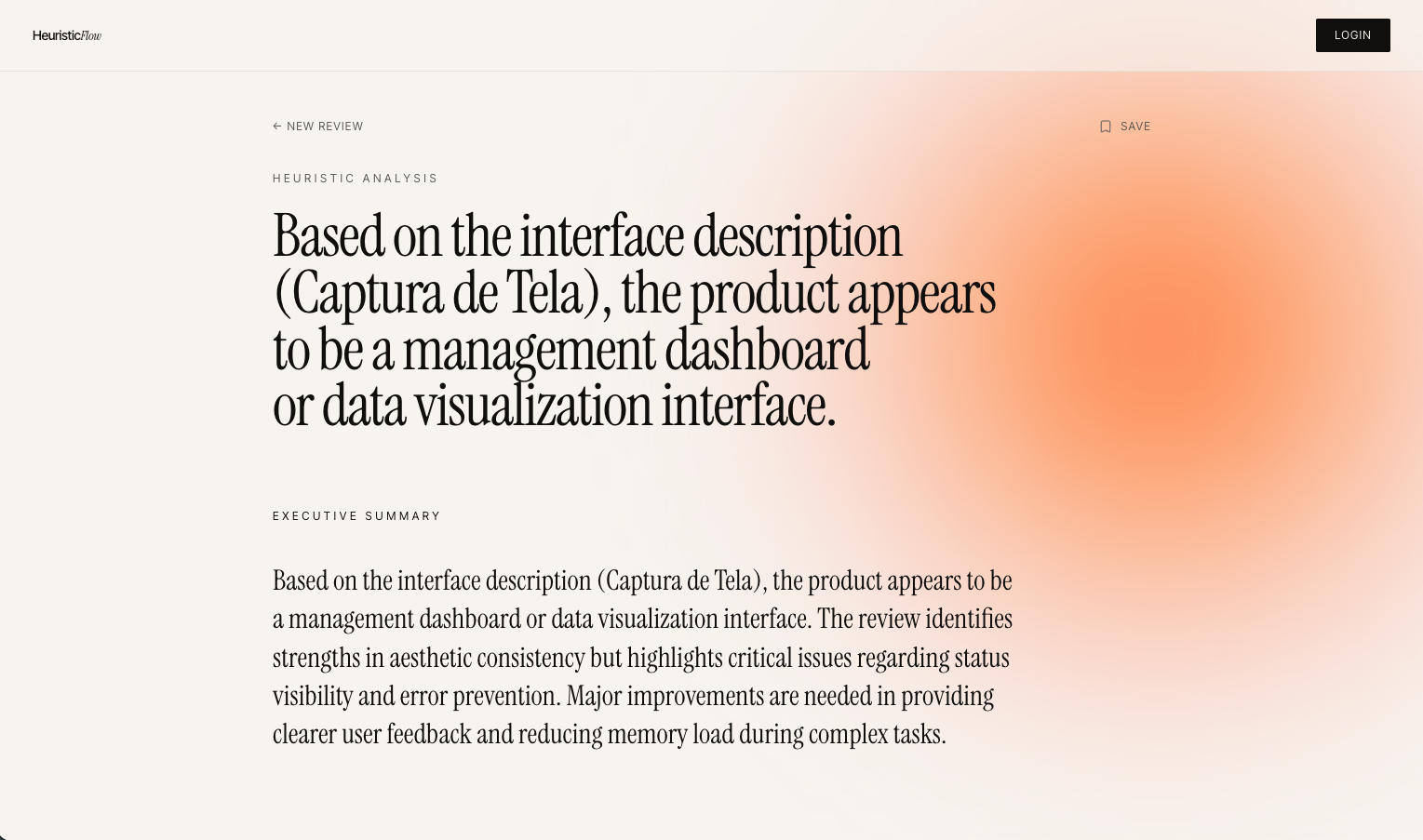
Heuristic Analysis & Executive Summary
The review begins with a combined heuristic analysis and executive summary designed to quickly establish contextual understanding of the described interface or user flow. Instead of immediately surfacing isolated usability issues, the AI first generates a concise synthesis of the overall experience, highlighting core interaction patterns, structural observations, and the most relevant UX concerns. This creates a strategic overview of the product experience before moving into deeper usability, accessibility, and opportunity analysis.
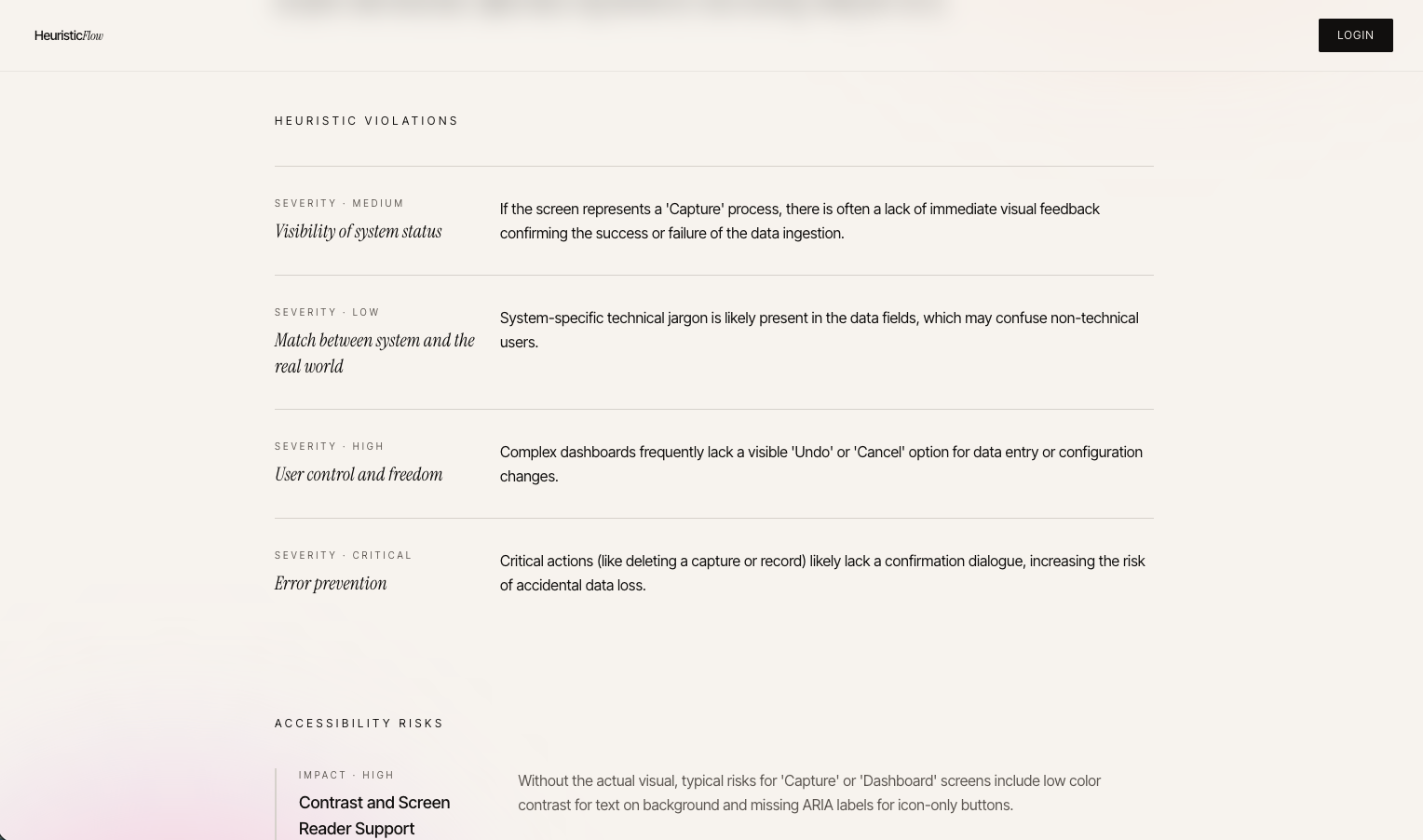
Heuristic Violations
The system identifies usability violations based on established UX heuristics and categorizes each issue according to severity levels: Low, Medium, High, or Critical. This prioritization layer helps transform raw feedback into actionable product direction by distinguishing minor interaction inconsistencies from issues capable of significantly impacting task completion or user trust.
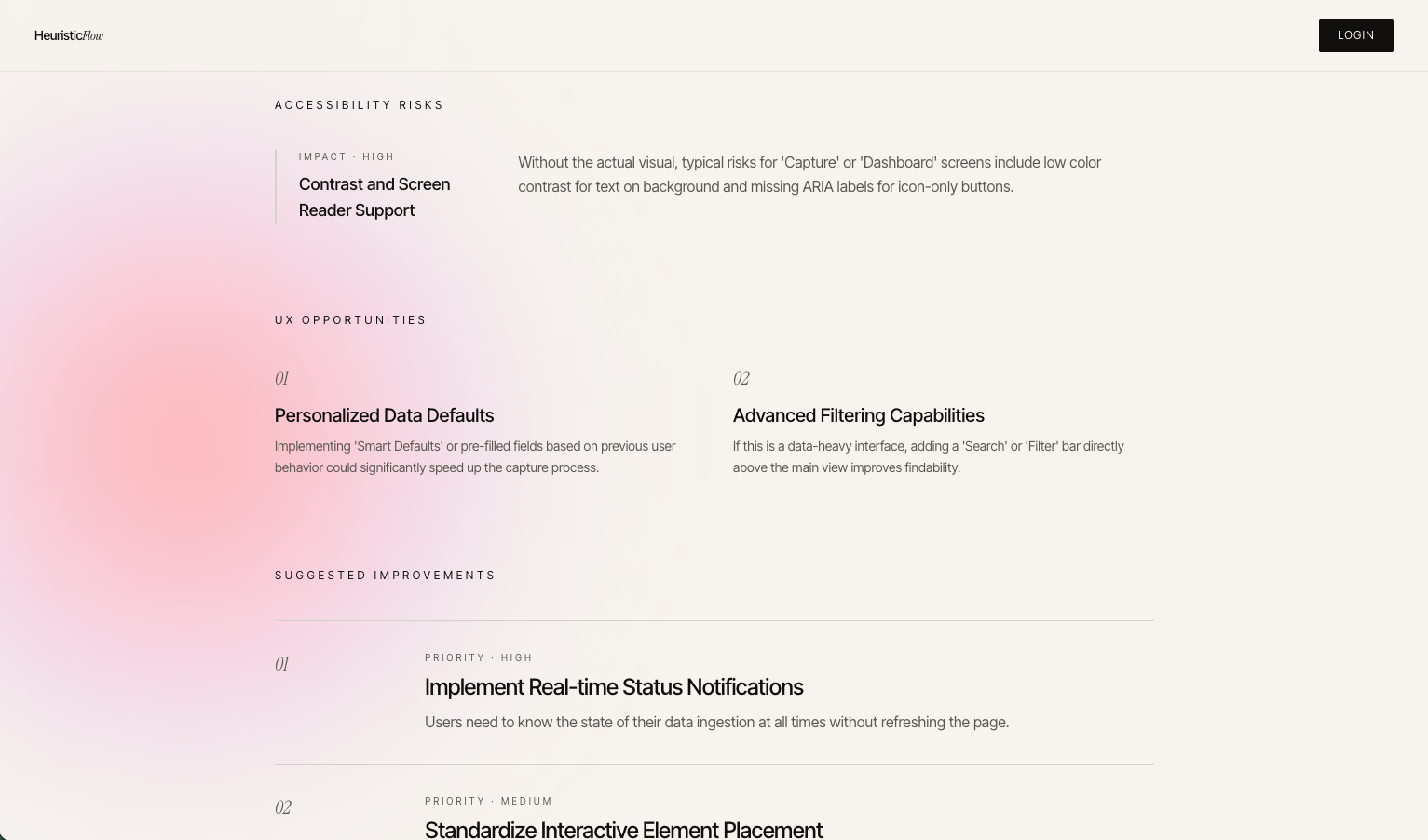
Accessibility Risks, UX Opportunities & Suggested Improvements
Beyond identifying usability problems, the review evaluates potential accessibility risks while also surfacing broader UX opportunities and actionable improvement recommendations across the experience. The analysis highlights areas that may negatively impact readability, interaction clarity, inclusivity, or cognitive accessibility, while simultaneously identifying ways to make the product more intuitive, efficient, and aligned with user expectations. To support iteration and decision-making, the system also generates practical design suggestions intended to transform heuristic findings into concrete product improvements.
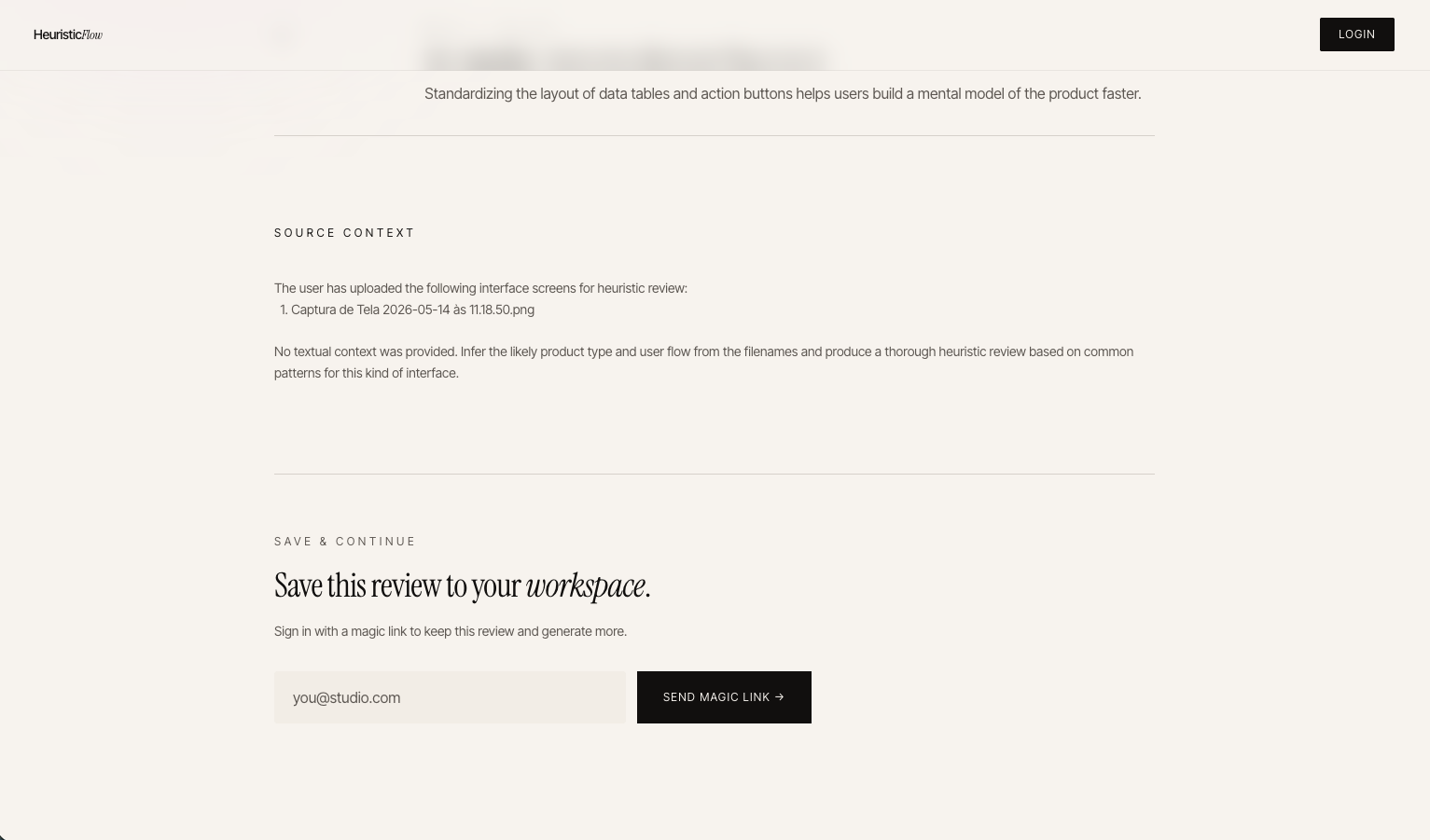
Source Context, Save & Continue
To maintain transparency and contextual grounding, the review includes the original source context used during the analysis, allowing users to reference the exact interface description, flow explanation, or product scenario that informed the AI-generated evaluation. After generating the review, users can save their analysis and continue the workflow through Magic Link authentication, reducing onboarding friction while reinforcing the feeling of a persistent and production-ready product experience.
Technical Decisions
Lovable as the Product Layer
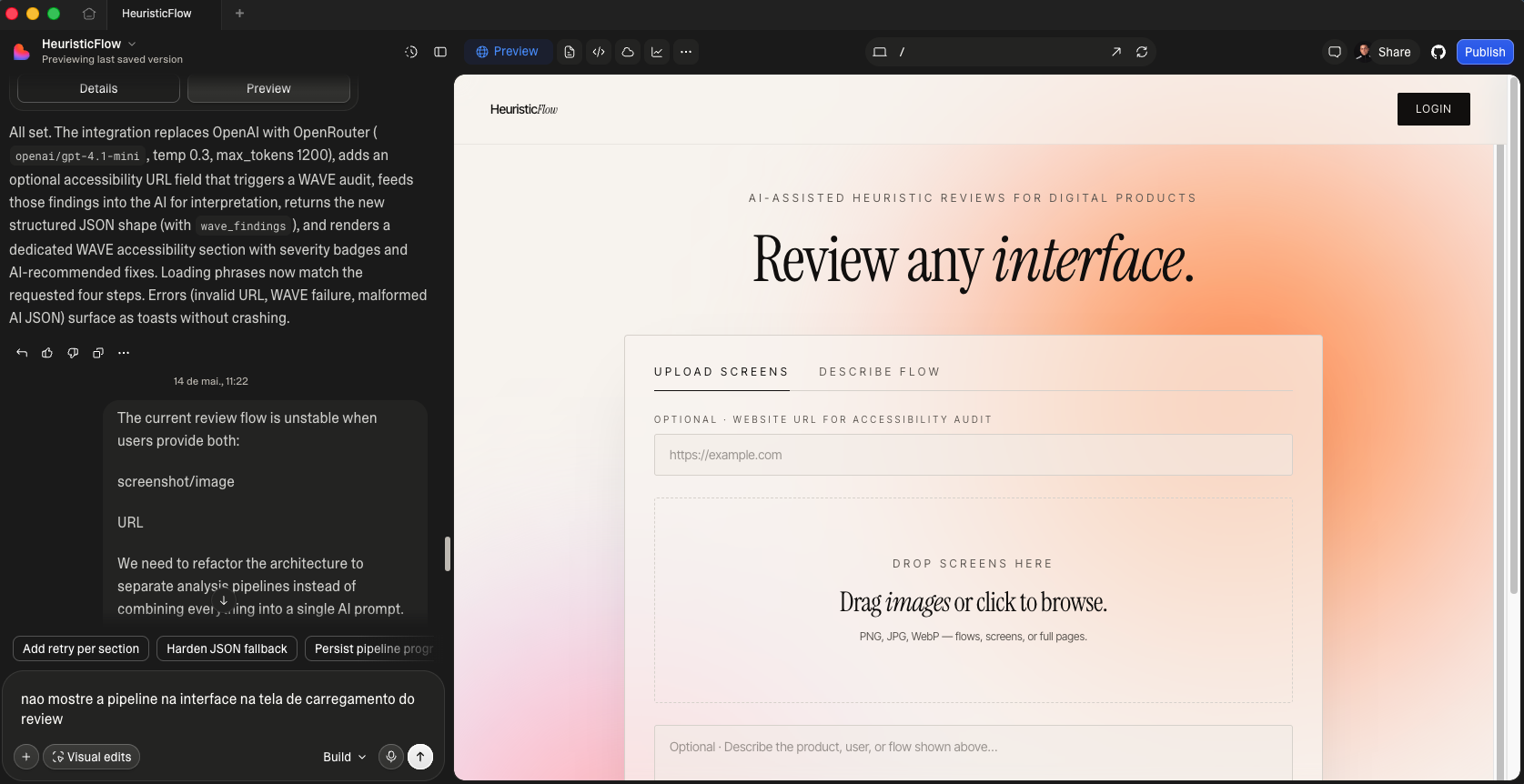
I used Lovable to accelerate:
page structure;
navigation;
component scaffolding;
frontend workflows.
The choice was not only about speed. It was about reducing friction between product thinking and execution.
Supabase for Authentication and Persistence
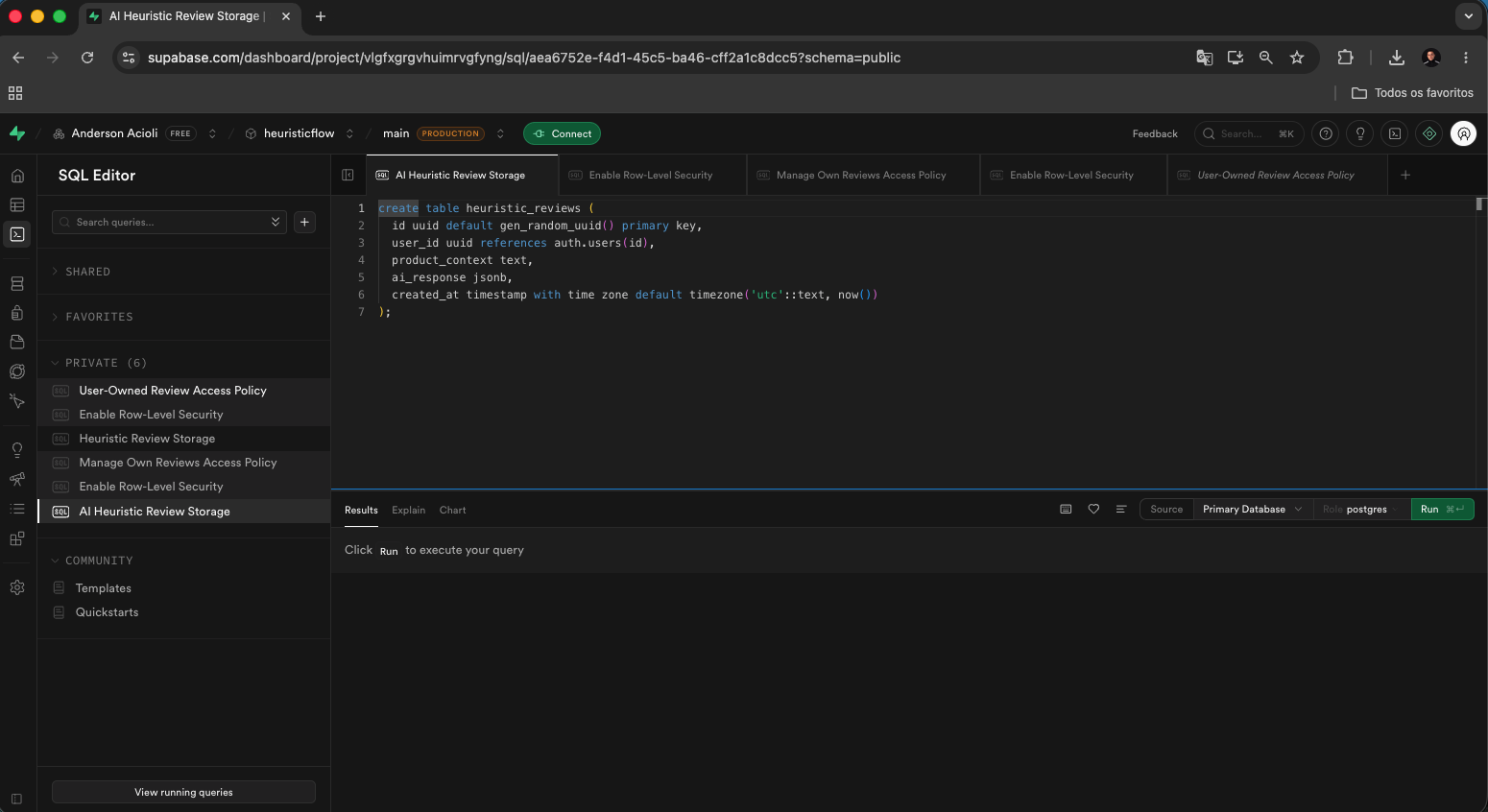
Supabase enabled a fast and reliable backend setup by combining integrated authentication, PostgreSQL infrastructure, and low operational overhead within a single platform. Using Magic Link authentication also helped reduce onboarding friction while immediately increasing the perception of a polished and production-ready product experience.
Structured AI Responses
Instead of returning free-form text, the AI output was organized into structured sections:
Heuristic Violations
Severity Level
UX Opportunities
Accessibility Risks
Suggested Improvements
This transformed the AI response from a generic chatbot interaction into a more operational product workflow.
Build Process
Day 1 — Foundation and Authentication
The first day focused entirely on infrastructure:
flow definition;
page architecture;
Supabase configuration;
authentication;
database setup;
navigation.
At this stage, visual refinement was intentionally ignored.
The priority was validating architecture and persistence.
Day 2 — Operational Workflow
With the foundation ready, I built:
dashboard structure;
persisted history;
CRUD operations;
loading states;
end-to-end review flow.
At this point, the product was already operational structurally, even before AI integration.
Day 3 — AI Integration and Refinement
The final phase focused on:
OpenAI integration;
structured prompting;
rendering AI outputs;
UX refinement;
responsiveness;
deployment.
The challenge was not only integrating AI technically, but turning that integration into a usable product experience.
The Biggest Learning
This project reinforced something I increasingly believe:
The biggest shift AI introduces is not automation itself.
It is the compression of product creation and learning cycles.
The ability to rapidly transform hypotheses into functional products is becoming a strategic advantage, especially in 0 → 1 environments.
The Role of Designers Is Changing
For years, design operated at a distance from implementation.
AI-assisted workflows are starting to collapse that separation.
Throughout this project, I worked simultaneously across:
problem definition;
product architecture;
UX design;
backend integration;
AI workflows;
system structuring;
operational product building.
More than designing screens, the role became:
orchestrating systems, decisions, and execution speed.
Outcome
At the end of the 3-day cycle, the MVP delivered:
functional authentication;
real backend infrastructure;
persistent storage;
AI integration;
structured heuristic reviews;
saved review history;
production deployment;
complete operational workflow.
All built within an extremely compressed validation cycle.
Final Reflection
This project was never about building a startup.
It was about exploring a new way of building products.
A workflow where:
designers build;
AI reduces operational friction;
validation happens earlier;
learning happens faster.
More than a technical experiment, this MVP became an exploration of AI-first product building.